Anthropic Just Metered the Agent SDK: What Breaks on June 15
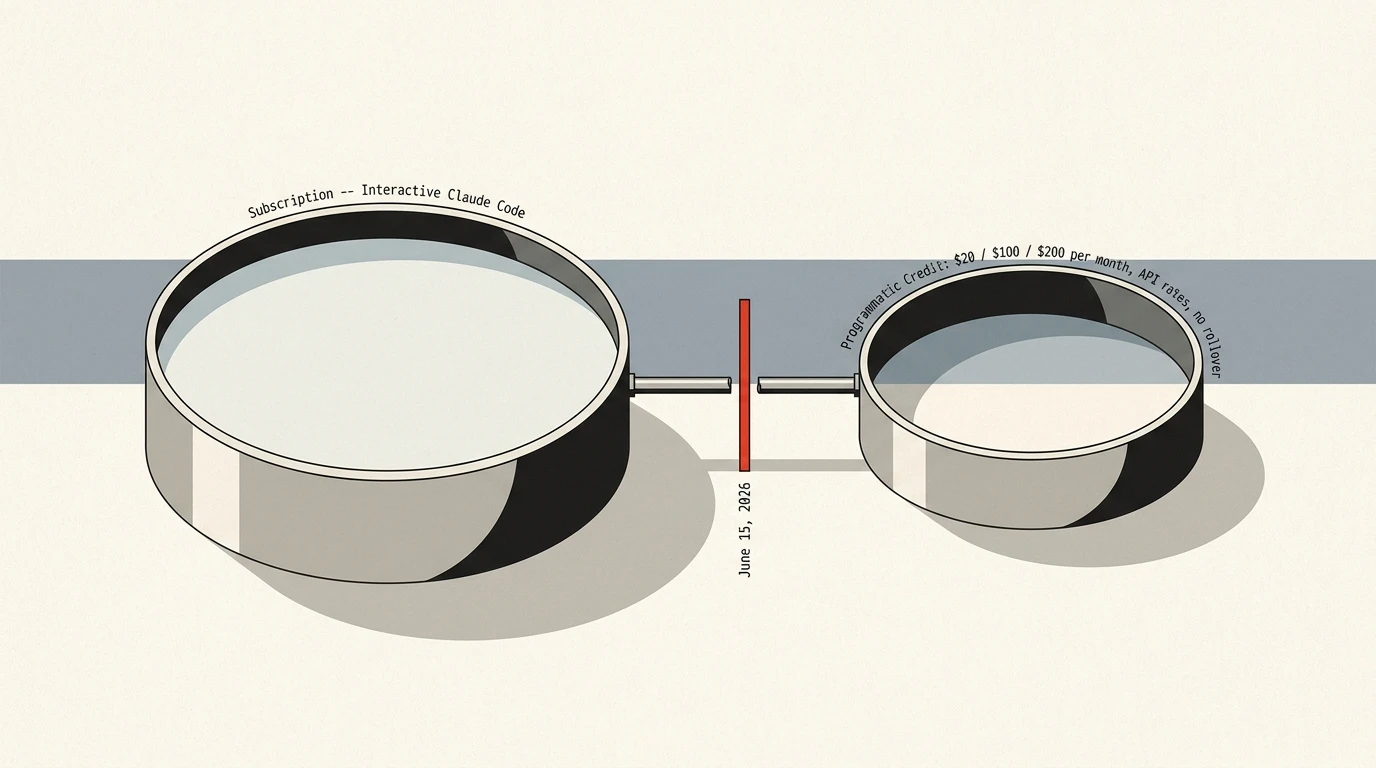
On May 13 Anthropic posted to @ClaudeDevs that starting June 15, the Claude Agent SDK and claude -p would draw from a separate $20-to-$200 monthly credit, billed at full API rates and not rolled over. Pro gets $20. Max 5x gets $100. Max 20x gets $200. T3 Code creator Theo Browne replied that his community’s effective cost just went up 25 times and cancelled within hours.
The announcement is documented in Anthropic’s own support article and recapped by InfoWorld, VentureBeat, The Register, The New Stack, and SiliconAngle within 48 hours (Anthropic support, 2026; VentureBeat, 2026). Browne, named in the same news cycle alongside Jeremy Howard, Matt Pocock, Omar Sanseviero, and Yadesh Salvi, calls it “an attack on open-source tooling that repudiates months of explicit promises from Anthropic’s developer relations team” (BigGo, 2026).
I ship Pylon, a native desktop client built on the Claude Agent SDK and the OpenAI Codex SDK. Every parallel review agent it dispatches, every plan-mode exploration, every PR-creation prompt against a Claude provider now bills against the new programmatic credit pool. The framing is “new credits”. The reality is the end of compute arbitrage. Both are correct. The interesting question is what the move says about where Anthropic thinks its revenue actually lives in 2026, and what the realistic alternatives look like.
What follows is the strategic read, the April-to-June timeline, the worked cost math, the explicit list of de-prioritised tools, Codex as the May-2026 refuge, and a four-step migration playbook before the cutover.
Key Takeaways
- On June 15 2026, Claude Agent SDK calls,
claude -p, Claude Code GitHub Actions, and any third-party app built on the Agent SDK move out of the subscription pool and into a separate monthly credit billed at full API rates and not rolled over (Anthropic support, 2026).- The monthly programmatic credit mirrors the subscription price: Pro $20, Max 5x $100, Max 20x $200 (The New Stack, 2026). The interactive Claude Code surface in the terminal continues to draw from the subscription pool and is unaffected.
- Power users put the effective cost increase at 25 to 40 times for the programmatic slice (BigGo, 2026). The defensible read is that a $20 Pro subscription could previously drive roughly $500 of equivalent API workload, and Anthropic engineered the smallest bound that keeps harness builders inside the subscription product (InfoWorld, 2026).
- The April 2026 ban on third-party Agent SDK consumers, reversed on May 13 with the meter as the price of admission, is itself the story. The five-month gap between Anthropic’s April “encourage local development and experimentation with the Agent SDK and Claude-P” promise and the May meter is the load-bearing process complaint (BigGo, 2026).
- As of May 2026 the only mature subscription-priced alternative is OpenAI’s Codex CLI, included in ChatGPT Plus ($20), Pro ($200), and Team ($25 to $30 per user) (OpenAI Codex pricing, 2026). Pylon already ships against both SDKs; the design lesson is that provider optionality is no longer optional.
What actually changes on June 15?
Four surfaces move out of the subscription pool starting June 15: the Claude Agent SDK in Python and TypeScript, the claude -p headless mode, the official Claude Code GitHub Actions, and any third-party app built on the Agent SDK (Anthropic support, 2026). The interactive Claude Code terminal CLI, the Claude.ai web product, and Claude Desktop all stay on the subscription pool.
Each plan ships with a fixed monthly programmatic credit that mirrors the subscription price: Pro $20, Max 5x $100, Max 20x $200 (The New Stack, 2026). Credits do not roll over and are billed at the full Anthropic API rates. The no-rollover policy is load-bearing because it kills “save up for a heavy week” workflows. The API-rate billing is load-bearing because it converts a previously-flat subscription into a per-token meter for the programmatic slice.
| Plan | Pre-Jun-15 programmatic | Post-Jun-15 interactive | Post-Jun-15 programmatic | Rollover |
|---|---|---|---|---|
| Pro | Subscription pool | Subscription pool | $20 credit at API rates | No |
| Max 5x | Subscription pool | Subscription pool | $100 credit at API rates | No |
| Max 20x | Subscription pool | Subscription pool | $200 credit at API rates | No |
| Team | Subscription pool | Subscription pool | Per-seat credit pool | No |
Translation at current API list prices: a Max 20x user gets roughly 13 million Sonnet 4.6 input tokens or 220,000 Opus 4.7 input tokens per month before the meter empties. An autonomous Opus-heavy agent loop can clear that in 36 to 72 hours of unattended work. The Anthropic Console workspace spend limits sit above the credit pool as a deterministic dollar cap; the credit pool is the first floor, the workspace limit is the second (Anthropic Console workspaces, 2026).
Interactive pool stays. Programmatic pool splits. The interactive slice is unaffected; the programmatic slice is metered at API rates with no rollover. If you have not measured your own usage mix yet, start with the personal token-tracking pipeline.
Why the April-ban-to-May-meter timeline tells the real story
In early April 2026 Anthropic banned third-party Agent SDK consumers on subscription plans citing “capacity and service issues”; on May 13 they reversed the ban and introduced the credit-pool meter (the-decoder, 2026). Read together, the two moves are not contradictions. They are the panic response and the engineered fix for the same constraint. The constraint is compute arbitrage: a $20 Pro plan could run agent loops that would have cost $500 on a direct API key.
The framing was capacity. The underlying constraint was margin. A Claude Code product manager publicly stated in April that the company wanted “to encourage local development and experimentation with the Agent SDK and Claude-P”; the last such promise arrived in April, after which Anthropic stopped responding (BigGo, 2026). The May meter contradicts the April promise. The silence in between is the process complaint Browne cites.
The May 13 reversal-plus-meter is the final shape. Anthropic’s announcement explicitly frames it as a reinstatement of third-party Agent SDK access, with the credit pool as the price of admission (VentureBeat, 2026). The defensible read: no rational vendor can subsidise unbounded compute-loop arbitrage indefinitely. If subscription tiers are to survive at all, programmatic loops have to be metered separately. The meter is the smallest move that bounds the arbitrage while keeping harness builders inside the subscription product.
The process complaint stands separately. Anthropic spent eighteen months actively courting the indie-tooling audience this policy de-prioritises, and the silent five-month contradiction is what makes the May reversal read as bad-faith even when the underlying pricing logic is defensible.
How big is the cost increase, actually?
The 25-to-40 times multiplier is real, also defensible from Anthropic’s side, and depends heavily on which workload you ran (BigGo, 2026). The honest number is “your previous effective cost was unbounded, your new effective cost is $200 of API-rate tokens; the multiplier is whatever your previous burn was, divided by $200”. InfoWorld and The Register call it the end of “compute arbitrage” where $20 Pro plans drove $500 of API workload (InfoWorld, 2026). Both framings describe the same number from opposite sides.
A Max 20x user previously had effectively-uncapped Agent SDK access for $200 a month. After June 15 they have $200 of API-rate credit. At current Sonnet 4.6 input pricing that is roughly 67 million tokens. At Opus 4.7 input pricing it is roughly 13.3 million tokens. An autonomous agent loop with mixed input and output, with Opus on the heavy hops, can burn that in 36 to 72 hours of unattended work.
Workload variance matters more than the headline multiplier. A claude -p ping in a cron is sub-dollar. An Agent SDK harness running parallel subagents on Opus 4.7 is double-digit per hour. The multiplier varies by an order of magnitude across those two cases on the same plan. The headline number is “25 to 40 times”. The per-workload number is what shows up in next month’s bill.
Public postmortems anchor the upper bound. The $47,000 four-agent LangChain loop and the $4,200 retry loop both fired Slack alerts on the way to their totals; neither was stopped. These are the workloads the new credit pool is sized against, and the workloads where the meter is, perversely, a feature rather than a bug. Salvi’s quote names the lower-bound complaint: “the monthly limit you are providing won’t even last a day of serious work” (The New Stack, 2026). Browne’s quote names the operational consequence: “I now have to make the Claude Code experience on T3 Code significantly worse” (The New Stack, 2026).
Cache-aware prompting is the largest single lever for cutting the metered slice. Prompt-cache hits are billed at a fraction of full input rates, and a well-structured strategy can flip a 60-percent-rate workload into a 5-percent-rate one on the same prompts; see the practical cache-shape rules in cache-aware prompting.
Which tools just got de-prioritised, and why Pylon is the worked example
The credit split is unambiguously the right move for Anthropic’s enterprise revenue and unambiguously the wrong move for grassroots tooling. The losers are explicit: T3 Code, Zed’s Claude integration, Conductor, OpenClaw, any GitHub Actions integration that ran on the Pro plan, the long tail of Agent-SDK-powered indie tools, and yes, Pylon (VentureBeat, 2026; SiliconAngle, 2026).
Pylon is a native desktop client built on the Claude Agent SDK and the OpenAI Codex SDK, connecting to existing Claude Code or Codex CLI authentication. The PR-review feature dispatches up to six specialised review agents in parallel per pull request: security, bugs, performance, style, architecture, UX. That is precisely the workload shape the new credit pool is sized against. Parallel subagents on Opus or Sonnet, dispatched on every PR, billed at API rates against a fixed $200 monthly ceiling. A single Max 20x credit pool absorbs roughly 30 to 40 of those reviews a month if Opus carries the heavy hops. After that the pool is empty.
The read on what just got de-prioritised: Anthropic has decided the enterprise API flywheel is now load-bearing and the grassroots subsidy is not. The historical analogy is how AWS treated its free-tier ecosystem once enterprise revenue dominated. The indie tooling did not vanish, but the unit economics shifted from “subsidised growth” to “metered cost”. Browne’s “an attack on open-source tooling that repudiates months of explicit promises” (BigGo, 2026) is the loudest reaction quote; it is also, by 48 hours after the announcement, an underread one.
The broader signal is that the unbundling is happening across vendors simultaneously. Cursor pooling, Copilot’s June 1 usage-based flip (GitHub Blog, 2026), and GitHub’s premium-request multipliers are all the same story. Subscription bundling for agentic workloads is coming apart at every vendor at once. The June 15 cutover is one beat in a much longer move.
The honest balance: some of the criticism is pricing-rage. Some is well-founded process complaint about the five-month silence after the April promise. The piece names both rather than picking the louder one.
Is Codex really the only refuge?
As of May 2026 the only mature alternative that bundles substantial programmatic-coding usage into a $20-to-$200 subscription tier is OpenAI’s Codex CLI (OpenAI Codex pricing, 2026). Cursor’s enterprise admin API and Gemini’s CLI are functional but priced as add-ons or still maturing as full programmatic surfaces. That Codex is the only refuge is itself the most interesting data point. Anthropic ceded the subscription-priced-agent slot, and OpenAI walked into it.
Codex CLI is included in ChatGPT Plus at $20, Pro at $200, and Team at $25 to $30 per user, with no standalone subscription; users can run additional local tasks against an API key at standard token rates (OpenAI Codex pricing, 2026). The headless invocation surface, the GitHub Actions parallel, and the rate-card are the close analogs to the Claude Code and Agent SDK shape.
Pylon is the lived migration reference. It already exposes both providers behind a shared session registry: a session-level model setting flips between Claude (Opus, Sonnet, Haiku) and Codex models without touching the rest of the application. The swap is mechanical, not a rewrite. I’ve run real PR-review workloads on Codex models for comparison; the differences are real but the migration path is short.
The honest tradeoffs: Codex is younger than Claude Code, the model-mix is different (GPT-5 family versus Opus and Sonnet), and the ecosystem of harnesses is thinner than Claude Code’s, though the gap is closing fast. For an Opus-heavy workload (long-context refactors, ambiguous specs) Codex is a regression on certain tasks. For many parallel-subagent workloads, the regression is small and the price stability is large.
The 12-month conventional-wisdom flip is the highest-information sentence in the post. For the eighteen months prior to May 2026, the conventional wisdom in the agentic-coding community was that Anthropic was the price-stable subscription choice and OpenAI was the metered-API choice. The June 15 cutover flips that. OpenAI is now the price-stable subscription choice for programmatic Claude-equivalent workloads, and Anthropic is the metered choice for the same surface.
Cursor at $20 to $40 per user with pooled usage is the IDE-bound alternative; the programmatic CLI surface is thinner. Gemini CLI is the cheapest-token-per-dollar option for non-frontier work; the harness ecosystem is the thinnest of the three. The temporal hedge: Codex will almost certainly meter its own programmatic surface within twelve months for the same compute-arbitrage reasons that drove the June 15 cutover. The refuge is real. It is also probably temporary. The design lesson Pylon embodies (provider optionality from day one) is what survives the next pricing round. Before swapping, verify the agent quality side with an eval harness.
What should you actually do between now and June 15?
Four weeks is enough time to measure, decide, migrate, and cap deterministically if you start this week. The migration is not “switch to Codex” or “swallow the credit cap”. It is “measure what fraction of your current Claude usage is programmatic, price it on the new regime, then decide which surfaces to keep on Claude and which to swap”.
Step 1, instrument. Pull the current spend mix using the Claude Code Analytics API endpoint GET /v1/organizations/usage_report/claude_code, which returns daily per-user, per-model rollups, or the JSONL-parsing approach from my prior post on tracking Claude Code usage. Output: a per-day, per-model, per-token-type table of the last 30 days, split by interactive versus programmatic.
Step 2, price the post-June-15 impact. Apply current Anthropic API rates to the programmatic slice only; the interactive slice is unchanged. Output: a dollar number for the metered slice that you compare to your plan’s monthly credit ($20, $100, or $200).
Step 3, evaluate the swap. For any workload where the metered slice exceeds the credit budget, run the same workload on Codex CLI with an eval harness. Output: a quality and cost comparison per workload, decided per workload, not as a blanket vendor switch.
Step 4, cap deterministically. Instrument a PreToolUse hook from the deterministic-hook substrate that blocks the next Agent SDK call when cumulative credit consumption crosses a configured threshold. The hook is the deterministic floor, the new credit pool is the dollar floor, and the workspace spend limit is the org-level floor. Three caps, layered.
Step 5, build for optionality. If you ship a desktop or CLI tool that consumes either SDK, build for provider optionality up front. Pylon’s shared provider registry is the reference shape: one session abstraction, two SDK adapters, model selection per session. The next pricing change is a config flip, not a rewrite. This is the recommendation that survives the next cutover.
Frequently Asked Questions
When does the Claude Agent SDK credit change take effect?
June 15 2026, announced May 13 2026 via Anthropic’s @ClaudeDevs channel and documented in the Claude support article (Anthropic support, 2026). The cutover applies to all paid subscription tiers (Pro, Max 5x, Max 20x, Team) and to any third-party application built on the Agent SDK or claude -p.
How much programmatic credit do I get per month?
Pro $20, Max 5x $100, Max 20x $200, billed at full Anthropic API rates with no rollover (The New Stack, 2026). Team plans get a per-seat credit pool on a similar shape. Once the credit is exhausted, programmatic calls error out; the interactive Claude Code surface continues working from the subscription pool.
Does Claude Code in the terminal still work on my subscription?
Yes. The interactive Claude Code CLI continues to draw from the existing subscription pool and is unaffected. Only claude -p, the Agent SDK, Claude Code GitHub Actions, and third-party Agent SDK harnesses move to the programmatic credit pool (Anthropic support, 2026). Interactive use on the same plan is unchanged.
Is there a subscription-priced alternative to the Agent SDK?
OpenAI’s Codex CLI on ChatGPT Plus ($20) or Pro ($200) is the closest analog in May 2026 (OpenAI Codex pricing, 2026). Cursor and Gemini CLI are functional alternatives with different pricing shapes. Pylon ships against both Claude and Codex SDKs as a reference for how to keep the swap mechanical when a vendor reprices.
What changed and what to do about it
The June 15 cutover is one event in a longer move. Three things worth keeping after this post fades:
- The split is real and load-bearing. Interactive pool stays; programmatic pool meters at API rates with $20 to $200 a month of credit and no rollover. The 25-to-40 times effective increase is real on the programmatic slice and defensible from the steelman side; the process complaint about the silent contradiction with the April promise is separate, and also valid.
- Codex inherits the price-stable-subscription slot Anthropic just vacated. That flips an eighteen-month conventional wisdom and probably lasts twelve months. Use it, but do not bet a tool on it.
- Provider optionality is no longer optional. Pylon’s shared provider registry is the reference shape: one session abstraction, two SDK adapters, model selection per session. The next pricing change is a config flip, not a rewrite. Build for the next cutover before it ships.
The honest move is to instrument first, decide per workload, cap deterministically, and ship for optionality. The cutover does not change which vendor is best. It changes which vendor is stable.
If it was useful, pass it along.