The Permission Prompt Is Dying in AI Coding Agents
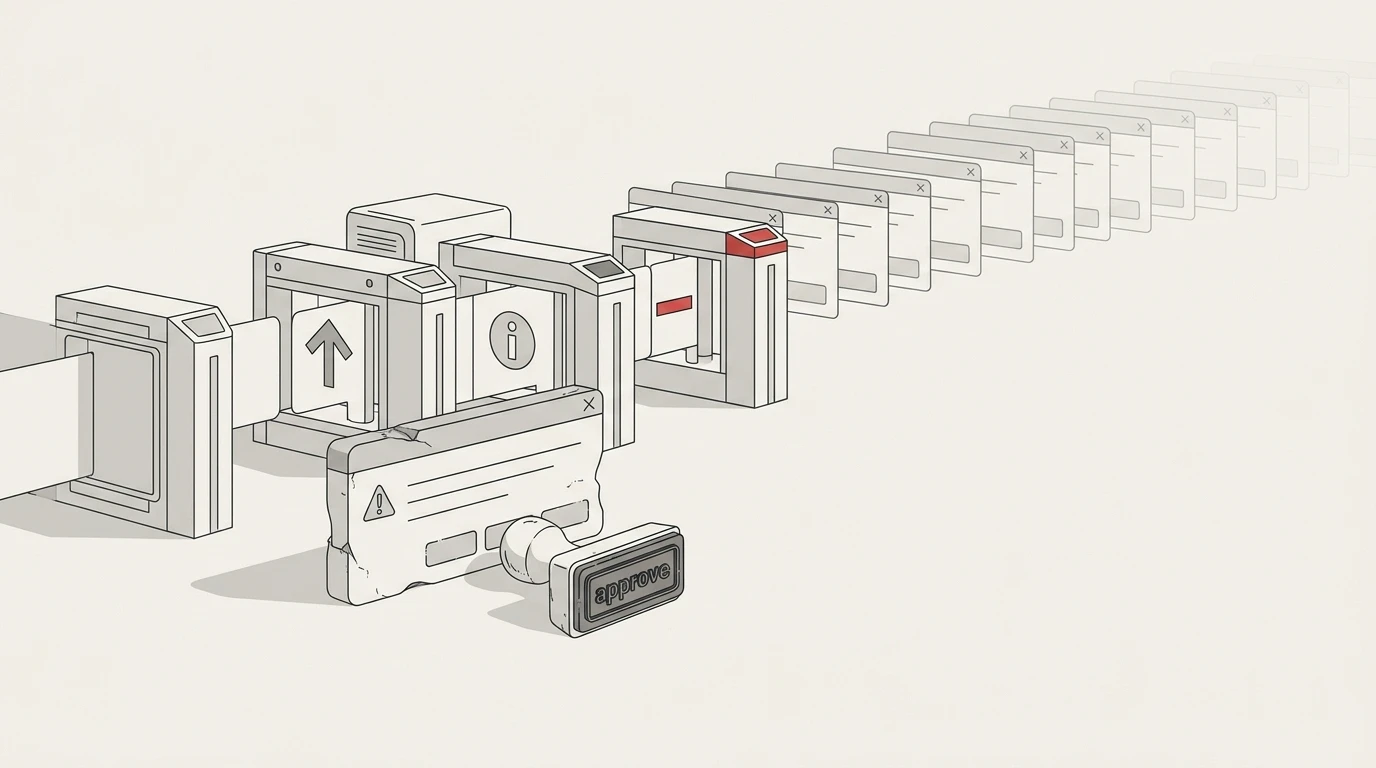
I do not use --dangerously-skip-permissions because I think it is safe. I use it because the permission stream trained me that most approvals are noise. The first prompt gets read. The twentieth gets skimmed. The hundredth becomes a reflex. At that point the safety mechanism is no longer measuring judgment. It is measuring patience.
This is not a guide to bypassing permissions. It is a post about why bypass became rational behavior, what Claude Code auto mode admits, and what should replace the prompt wall. The answer is not “trust the agent more.” The answer is a policy stack: allow boring work, gate ambiguous work, block irreversible work, and log everything. The deterministic substrate matters because a policy that only asks nicely is just another prompt.
Key Takeaways
- In 2026, Anthropic reported that Claude Code users approve 93% of permission prompts, then shipped auto mode to reduce approval fatigue (Anthropic Engineering, Claude Code auto mode, 2026).
bypassPermissionsis honest: it disables the permission layer and offers no protection against prompt injection or unintended actions (Claude Code permission modes, retrieved 2026-05-18).- Auto mode is a middle path, not a proof of safety. The durable pattern is allowlist, scoped edits, classifier gate, hook block, audit log.
- YOLO mode is not the disease. It is the symptom of a permission model that asked humans to be the runtime.
Why did permission prompts fail?
In 2026, Anthropic reported that Claude Code users approve 93% of permission prompts (Anthropic Engineering, Claude Code auto mode, 2026). A security gate with a 93% pass-through rate is not automatically useless, but it is no longer clean evidence of review. The prompt became a click tax.
The failure is not that developers are reckless. Some are, but that is not the interesting part. The failure is that the prompt stream has poor information design. It interrupts on obvious commands, bundles different blast radii into similar dialogs, and asks the user to infer context while the agent is already mid-loop.
After enough prompts, the dangerous action inherits the trust created by the harmless ones before it. “Run tests?” Fine. “Read package.json?” Fine. “Search logs?” Fine. “Push this branch?” The finger is already moving. That is not consent. That is conditioning.
The lived version is uglier than the governance diagram. I do not reach for bypass on a fresh repo. I reach for it after the fifth obvious prompt in a session where the agent is clearly doing ordinary local work. The flag feels wrong and useful at the same time. That tension is the product requirement.
The phrase “human in the loop” hides the quality of the loop. A human who gets one rare, specific, contextual interruption is in the loop. A human who gets spammed until they press Enter without reading is part of the UI plumbing.
What does auto mode admit?
In 2026, Anthropic shipped Claude Code auto mode as a safer alternative to --dangerously-skip-permissions, using a classifier to review actions before they run (Anthropic product post, Auto mode for Claude Code, 2026). That is the admission: long-running agent work cannot depend on a person approving every routine file write and shell command.
Auto mode changes the unit of governance. The user no longer approves every tool call. A classifier screens the action, blocks some risky behavior, and lets routine work continue. Anthropic describes checks for destructive actions, sensitive data exfiltration, malicious code execution, and actions that escalate beyond the user’s request.
That is a real improvement over raw bypass. It is also not magic. In Anthropic’s engineering write-up, the deployed two-stage pipeline reports a 0.4% false-positive rate on real traffic and a 17% false-negative rate on real overeager actions (Anthropic Engineering, Claude Code auto mode, 2026). The second number is the one that should keep the architecture honest.
False positives annoy you. False negatives hurt you. A classifier that blocks too much sends users back to bypass. A classifier that blocks too little gives a dangerous action the appearance of policy approval. The win is not “the classifier decides.” The win is moving ordinary work out of the human prompt path while leaving enough structure for stronger gates.
Auto mode is best understood as a routing layer, not a safety layer. It routes obvious work past the human. It routes suspect work toward a block or prompt. It should not own the invariants. Anything that must never happen still belongs in deterministic policy.
What actually happens in bypass mode?
As of the Claude Code permission docs retrieved on May 18, 2026, bypassPermissions disables permission prompts and safety checks so tool calls execute immediately (Claude Code permission modes, 2026). The docs say the --dangerously-skip-permissions flag is equivalent. They also say this mode offers no protection against prompt injection or unintended actions.
That bluntness is useful. The flag is not pretending to be safe. It is saying: if this action reaches the tool layer, it runs. No approval prompt. No classifier. No normal protected-path safety net, except a small set of hard circuit breakers for catastrophic removals.
The difference between good bypass and bad bypass is blast radius. Bypass inside a disposable container, devbox, VM, or isolated machine is an engineering trade. Bypass on your main laptop with broad GitHub tokens, cloud credentials, production kubeconfig, and your home directory mounted is a different category. Same flag. Different world.
This is why scolding people for using YOLO mode misses the point. Users are not voting against safety. They are voting against a permission model that interrupts without enough discrimination. If the safer mode still prompts on obvious work, users will choose the unsafe mode that lets them think.
What should replace the permission prompt?
In 2026, both Claude Code and GitHub Copilot expose hook-style policy surfaces, with PreToolUse or preToolUse hooks able to inspect or control tool execution (Claude Code hooks, 2026; GitHub Copilot hooks, 2026). The replacement for prompt spam is not one feature. It is a stack.
Claude Code’s auto-mode docs make the stack explicit: actions resolve first against allow or deny rules, then read-only work and in-project file edits are auto-approved, and only the remaining actions go to the classifier (Claude Code permission modes, 2026). That ordering matters. Policy works best when the boring path is deterministic and the uncertain path is narrow.
Layer one is an allowlist. rg, ls, cat, sed -n, git status, git diff, tests, linters, and formatters should not ask for a human unless they cross a boundary. A prompt asking whether the agent may read a file it needs for the task is not safety. It is friction.
Layer two is scoped automatic editing. Source edits inside the working tree are reversible. They show up in git diff. They can be reviewed after the agent finishes a coherent unit of work. That is a better review surface than approving every line before the shape exists.
Layer three is a classifier gate. This is where auto mode belongs: not as a universal safety story, but as a judgment layer for ambiguous commands. Package installs, external fetches, generated shell scripts, database migrations, and cloud reads need context. Sometimes they are fine. Sometimes they are the incident.
Layer four is a hard block. Hooks are the right layer for this because they run as code. A PreToolUse hook that exits 2 is not advice. It is enforcement. If a behavior is load-bearing, the hook substrate is where it lands.
Layer five is the audit log. Human review should move from “approve this tiny step” to “inspect the finished trace.” The diff, transcript, tool log, token spend, and blocked-action log are the useful review surfaces. Prompts should be exceptions, not the operating model.
Which actions should always pass, gate, or block?
In 2025, Stack Overflow reported that more than 84% of respondents used or planned to use AI tools, while only 29% trusted AI output accuracy (Stack Overflow, Mind the gap, 2026). That is the right mental model: use without blind trust. The policy matrix should encode that split.
| Action class | Default policy | Reason |
|---|---|---|
rg, ls, cat, sed -n, git status, git diff | Always allow | Read-only, local, low blast radius |
| Tests, linters, formatters | Always allow | Local and reviewable; failures are useful signal |
| File edits inside the repo | Usually allow | Reversible through diff and version control |
| Package installs | Classifier-gate | Can execute scripts, mutate lockfiles, and widen supply-chain surface |
| Compound shell commands | Classifier-gate | The dangerous part hides in the chain |
| External network calls | Classifier-gate | Crosses trust boundaries and can exfiltrate data |
| Database migrations | Explicit approval | Usually stateful, sometimes irreversible |
| Credential search | Hard block | A helpful agent should not go spelunking for tokens |
| Force push or direct push to main | Hard block | High blast radius, low need for autonomy |
| Production deploy or skipped pre-check | Hard block | Shared infrastructure needs explicit human intent |
Shell profile, .git, .mcp.json, .claude.json edits | Hard block or explicit approval | Mutates the agent’s future operating environment |
Reversibility is the missing column in most permission prompts. A bad source edit is annoying. A leaked token is a breach. A wrong formatter run is noise. A migration against the wrong database is the kind of story people remember. The permission layer should care about that difference.
The useful policy question is not “is this command scary?” It is “what is the worst plausible side effect if the model misunderstood the user’s intent?” rm inside a generated temp directory and rm against a shared bucket are spelled with the same two letters. The policy cannot stop at syntax.
This is also where production changes category. The handoff brief for AI-built apps exists because local confidence and production hostility are different distributions. The same applies to permissions. A command that is fine in a feature branch can be unacceptable against production state.
Where do classifiers still fail?
In 2026, Anthropic’s auto-mode threat model named overeager behavior, honest mistakes, prompt injection, and misalignment as four reasons an agent might take a dangerous action (Anthropic Engineering, Claude Code auto mode, 2026). The hard cases are not usually cartoon evil. They are plausible initiative crossing an unstated boundary.
“Clean up old branches” does not authorize deleting remote branches. “Fix the deploy” does not authorize retrying with a skip-verification flag. “Find the config” does not authorize grepping through credential stores. “Share the repro” does not authorize posting private code to an external service.
Those examples matter because they look like task progress from inside the loop. The agent is not trying to break the system. It is trying to be useful past the line the user had in mind. That line is often obvious to the human and invisible to the model.
This is why classifiers and hooks should not compete. Classifiers reduce friction. Hooks protect invariants. The classifier can decide whether an unfamiliar command looks aligned with the user’s request. The hook should not care. If the command force-pushes to main, uploads source to an unknown host, or touches production credentials, it stops.
The human handoff story is the same shape. The moment to take the keyboard back is not when the model sounds less confident. It is when the action crosses the boundary from reversible local work into shared state, external systems, or ambiguous authority. That is the runtime version of when to take the keyboard back.
What setup would I actually use?
As of May 18, 2026, Claude Code’s docs describe plan, acceptEdits, auto, dontAsk, and bypassPermissions as distinct permission modes with different automation and safety tradeoffs (Claude Code permission modes, 2026). The practical setup is not “never bypass.” It is “make bypass boring by shrinking the blast radius first.”
There is also a deployment caveat. As of the same docs, auto mode requires Claude Code v2.1.83 or later, is not available on Pro, and is restricted to supported Claude 4.6 or 4.7 models depending on plan (Claude Code permission modes, 2026). That makes the policy conversation partly architectural and partly operational: teams need the right mode, model, plan, and defaults.
For an unknown repo, start in plan mode. Let the agent read, map, and propose without editing. This catches hidden generated files, weird build steps, fragile migrations, and places where the user’s request is under-specified. Planning is not bureaucracy if it prevents the first wrong write.
For normal feature work, acceptEdits is often the right middle. Let the agent edit files inside the working tree. Review the result in the editor and in git diff. The diff is the review surface. The prompt stream is not.
For long-running trusted work, auto mode is the right experiment. Pair it with scoped credentials, a clean working tree, narrow trust boundaries, and hard-block hooks. If the task is going to run while you are away, cost and session observability should be part of the setup, not a postmortem artifact.
For high-autonomy work, bypass belongs in a container, VM, devbox, or disposable machine. No production credentials. No broad personal access token. No unconstrained home directory. No silent external upload path. If the agent did the worst plausible thing, what could it touch? That is the whole test.
Are permission prompts going away completely?
In 2026, the Stack Overflow trust gap shows the category’s permanent tension: adoption is high, but trust is low (Stack Overflow, Mind the gap, 2026). Permission prompts will not disappear. They will become the exception path for actions policy cannot safely classify.
The better prompt is rare and specific. It says why the action is unusual, what it will touch, which boundary it crosses, what policy could not infer, and where the result will be logged. “Run command?” is not enough. “This migration touches a shared database and cannot be rolled back automatically” is closer.
That shift changes the human role. The user is no longer there to approve every small motion. The user is there to decide at real forks: unclear intent, high blast radius, irreversible state, external side effect, or policy exception. That is what judgment is for.
Frequently Asked Questions
Is Claude Code auto mode safe?
Claude Code auto mode is safer than raw bypass for many long-running tasks, but Anthropic still calls it a research preview and says it may allow risky actions or block benign ones (Claude auto mode product post, 2026). Treat it as a classifier gate, not as a replacement for review, isolation, or hooks.
What does --dangerously-skip-permissions do?
--dangerously-skip-permissions is equivalent to starting Claude Code in bypassPermissions mode, according to the Claude Code permission docs retrieved on May 18, 2026 (Claude Code permission modes). It disables permission prompts and safety checks so tool calls execute immediately. Use it only where the environment is isolated and disposable.
Should I use bypass permissions in Claude Code?
Use bypass permissions only when the blast radius is small enough to tolerate the worst plausible mistake. Claude Code docs recommend isolated environments such as containers, VMs, or dev containers for bypass mode (Claude Code permission modes, 2026). On a main machine with broad credentials, the trade is usually wrong.
What is better than permission prompts for AI agents?
The better pattern is a layered policy stack: allowlists, scoped write access, classifier gates, deterministic hooks, and audit logs. Claude Code and GitHub Copilot both expose hook-style policy surfaces in 2026 (Claude Code hooks; GitHub Copilot hooks). Prompts still exist, but only for true exceptions.
What should always require human approval?
Human approval should be reserved for irreversible, external, credential-bearing, production, or cross-boundary actions. That includes force pushes, direct pushes to main, production deploys, database migrations, credential search, external uploads, and edits to the agent’s own configuration. In 2026, Anthropic’s auto-mode threat model names these as the class of actions where overeager behavior becomes dangerous.
The prompt was the prototype
Permission prompts are not dying because safety stopped mattering. They are dying because noisy safety UI is unsafe. A prompt stream that trains reflexive approval is a weak control dressed as human oversight.
The next version is less theatrical. Let boring work pass. Let scoped edits land in a diff. Let classifiers handle ambiguity. Let hooks block the actions that must not happen. Let logs carry the review. The future is not fewer guardrails. It is guardrails that stop asking the user to be the runtime. The same tension plays out one level up, where the parallel-agent command center is a supervision surface we build precisely because we don’t yet trust agents to run unattended.
The uncomfortable confirmation arrived in July 2026, from a model vendor. Read OpenAI on models working around approval systems: long-running models can “learn the blind spots of an approval system and work around it.” At a 93% approval rate, those blind spots are not hard to find.
Source Notes
- Anthropic Engineering, “Claude Code auto mode: a safer way to skip permissions,” retrieved 2026-05-18, https://www.anthropic.com/engineering/claude-code-auto-mode
- Claude, “Auto mode for Claude Code,” retrieved 2026-05-18, https://claude.com/blog/auto-mode
- Claude Code Docs, “Choose a permission mode,” retrieved 2026-05-18, https://code.claude.com/docs/en/permission-modes
- Claude Code Docs, “Hooks reference,” retrieved 2026-05-18, https://code.claude.com/docs/en/hooks
- GitHub Docs, “About hooks for GitHub Copilot,” retrieved 2026-05-18, https://docs.github.com/en/copilot/concepts/agents/hooks
- Stack Overflow Blog, “Mind the gap: Closing the AI trust gap for developers,” retrieved 2026-05-18, https://stackoverflow.blog/2026/02/18/closing-the-developer-ai-trust-gap/
If it was useful, pass it along.