Open Weight vs. Frontier: A Realistic 2026 Coding Verdict
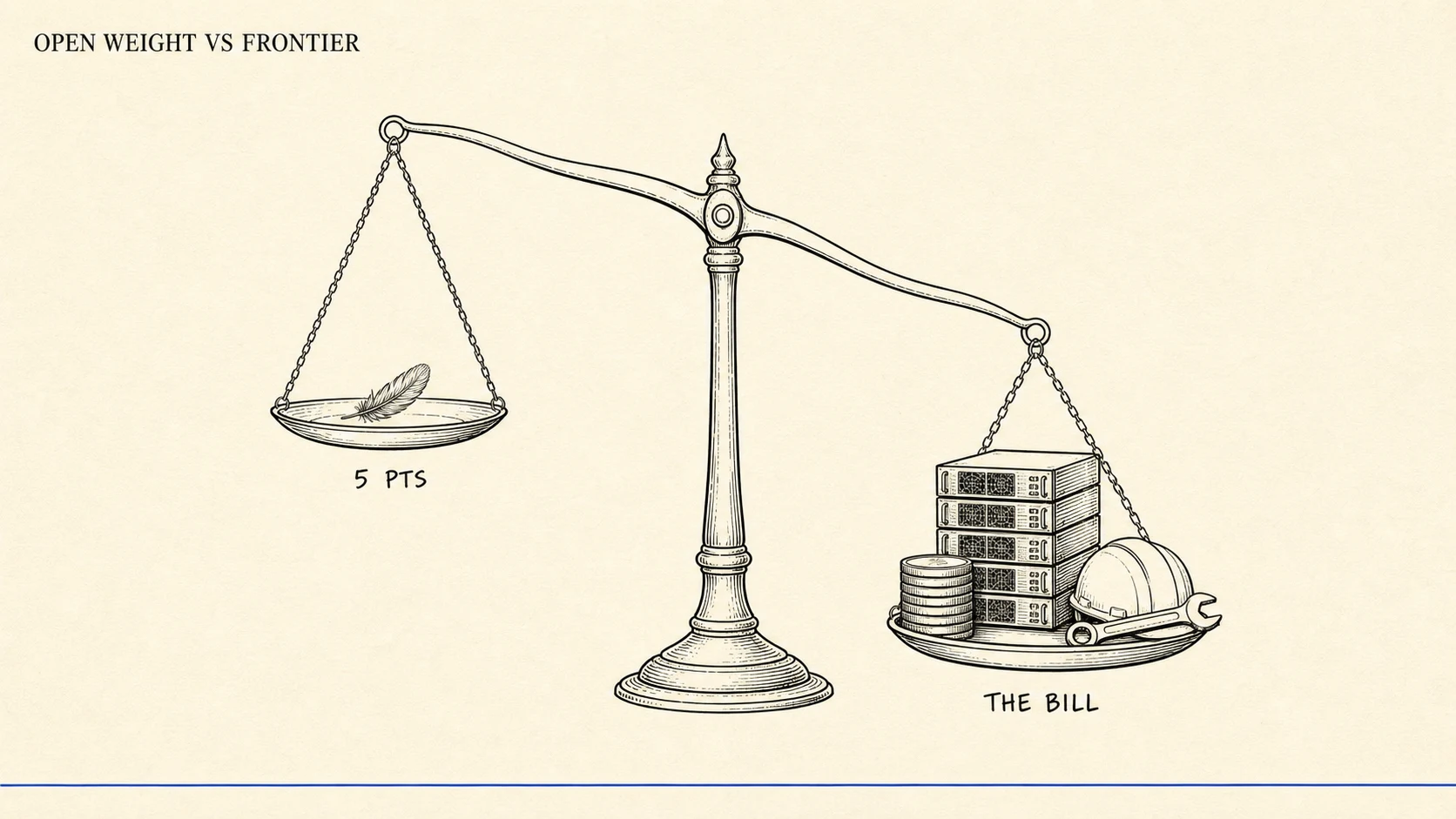
The headline is real. GLM-5.2, the strongest open-weight coder of 2026, lands about five to ten points behind the frontier on most evaluations, at roughly one-sixth the token price (Digital Applied, 2026). If you read only the leaderboard and the price sheet, the conclusion writes itself: switch. That conclusion is wrong for most teams, and the reasons are more interesting than the headline.
Every ranking post frames this as a duel and stops at price-per-token. That skips the two numbers that actually decide it: your utilization and your data constraints. A model that is cheaper per token can be more expensive per month. A model that wins the benchmark can lose on your codebase. And a five-point gap can be smaller than the noise between two versions of the same test.
Here is the tell. In June 2026, open-weight models ran 29% of all tokens through Vercel’s production gateway while accounting for under 4% of spending (Vercel, via Rajat Pandit, 2026). That is not a forecast. It is the verdict already playing out: open weight won the cheap, high-volume work, and frontier still gets paid for the hard, expensive work. The realistic move is to route, not switch.
Key Takeaways
- Open-weight coders closed the gap from 20-30 points in 2023 to 5-10 points by early 2026, but the remaining gap concentrates in the hardest work (callsphere, 2026). Claude Opus 4.8 leads GLM-5.2 by 13 points on the long-horizon SWE-Marathon and by only 0.7 on FrontierSWE (Digital Applied, 2026).
- The token price is the smallest line on the bill. Self-host below scale and an idle GPU at 10% utilization costs roughly 10x its headline rate per token, more than a premium API (Digital Applied, 2026).
- Benchmarks don’t predict your codebase. MiniMax M2.5 scores 80.2% on SWE-bench Verified and 39.6% on SWE-Rebench (Botmonster, 2026).
- Open weight already runs 29% of tokens at under 4% of spend (Vercel, via Rajat Pandit, 2026). That is the routing verdict. Send the cheap turns to open weight and keep the hard ones on frontier.
How far behind is open weight, really?
Close on paper, and it depends entirely on the task. In 2026, Claude Opus 4.8 scores 88.6% on SWE-bench Verified, while GLM-5.2 scores 62.1% on SWE-bench Pro and loses every shared benchmark (CodingFleet, 2026). GLM-5.2 is no toy. It is a roughly 753B-parameter open-weight mixture-of-experts model from Z.ai. It has 40B active parameters, a 1M-token context, an MIT license, and a June 13, 2026 release.
The gap is narrow on some axes and wide on others. Opus 4.8 leads GLM-5.2 by only 0.7 points on FrontierSWE and 0.8 on MCP Atlas, but by 13 points on SWE-Marathon, the long-horizon multi-file test that looks most like real engineering (Digital Applied, 2026). Read that shape carefully. The open-weight model is at parity on bounded tasks and falls behind exactly where the work gets long and interdependent.
The trend is genuine. The open-versus-proprietary gap narrowed from 20-30 points in 2023 to 5-10 points on most evaluations by early 2026 (callsphere, 2026). But “5-10 points behind” and “at parity on the work that pays your salary” are different claims. The second one is not true yet.
Citation capsule: In 2026, the open-weight coding gap is narrow but concentrated in the hardest work. Claude Opus 4.8 scores 88.6% on SWE-bench Verified and leads the strongest open-weight model, GLM-5.2, on every shared benchmark (CodingFleet, 2026). The lead is 0.7 points on FrontierSWE but 13 points on the long-horizon SWE-Marathon (Digital Applied, 2026), so open weight reaches parity on bounded tasks and falls behind on long, interdependent ones.
Why is the token price the smallest line on the bill?
Because the per-token saving only applies if you rent the model as an API. In 2026, GLM-5.2 runs about $4.40 per million output tokens against Opus 4.8’s $25, roughly 5.7x cheaper (BuildFastWithAI, 2026). DeepSeek V4 Pro is cheaper still, at $0.435 and $0.87 (Codersera, 2026). Self-host that same model, though, and the economics invert below scale.
The break-even is a range, not a line. It sits somewhere between 100M and 500M tokens per month, and it moves with model tier, GPU price, and utilization (Digital Applied, 2026). Utilization is the variable that quietly kills the price advantage. At roughly 10% GPU utilization, your real cost per token is about 10x the headline rate. That makes an idle H100 more expensive per token than a premium frontier API.
The rest of the bill is worse than the GPU line suggests. Hidden costs, the DevOps salaries, the model-update cycles, and the infrastructure overhead, add a 3-5x multiplier on top of the raw GPU rate, and a single H100 runs roughly $1,100 to $7,300 a month depending on commitment (Digital Applied, 2026). I priced this out for my own workload, a bursty five-subagent review pipeline nowhere near sustained load, and kept the frontier API. The per-token saving was real. The per-month cost was not.
Citation capsule: The open-weight per-token price only applies as a rented API. GLM-5.2 is about 5.7x cheaper than Opus 4.8 per output token (BuildFastWithAI, 2026), but self-hosting below scale inverts that. At 10% GPU utilization the real cost per token is roughly 10x the headline rate, and hidden operational costs add a 3-5x multiplier (Digital Applied, 2026).
Benchmarks are not your codebase
A five-point index gap is smaller than the noise between two benchmarks. In 2026, MiniMax M2.5 scores 80.2% on SWE-bench Verified and 39.6% on SWE-Rebench, while Claude Opus 4.6 goes from 80.8% to 51.7% on the same swap (Botmonster, 2026). If changing the test moves a model 30 points, a 5-point leaderboard gap is not deciding your production outcome.
SWE-bench Verified and Pro are the most useful public tests, because they use real GitHub issues that a model must resolve with a working patch. They are still isolated, self-contained tasks. Your work is not. Real engineering spans the full stack, reasons across a codebase, and trades off constraints no benchmark encodes. The practical consequence is that the leaderboard is the wrong tiebreaker. Use public benchmarks to build a shortlist, then decide on your own eval harness against your own repo. The gap that matters is the one you measure on your code, not the one a vendor measures on theirs.
Citation capsule: A five-point benchmark gap is smaller than the variance between benchmarks. MiniMax M2.5 drops from 80.2% on SWE-bench Verified to 39.6% on SWE-Rebench, and Opus 4.6 falls from 80.8% to 51.7% on the same change (Botmonster, 2026). Public benchmarks belong in the shortlist step; the deciding evaluation runs on your own codebase.
What does open weight genuinely win?
Volume, control, and constraint. In June 2026, open-weight models ran 29% of all tokens through Vercel’s gateway, up from roughly one-ninth in April, while spending stayed under 4% of the total (Vercel, via Rajat Pandit, 2026). Open weight already owns the cheap, high-volume floor, and it does so on economics, not ideology.
The rest of the wins are about where the data has to live and who controls the model. Protected health and financial data legally cannot leave a controlled perimeter. A closed API sends tokens to someone else’s servers by definition. The EU AI Act becomes fully applicable on August 2, 2026, which pushes regulated workloads toward self-hosting (Computing, 2026). Add no rate limits, the freedom to fine-tune, and no vendor lock-in, and the pattern is clear. F5’s 2026 research found organizations running or evaluating an average of seven models, with 78% operating some inference themselves (Kai Waehner, 2026). Nobody is picking one side.
Citation capsule: Open weight wins on volume, control, and constraint. In June 2026 it ran 29% of Vercel gateway tokens at under 4% of spend (Vercel, via Rajat Pandit, 2026). Self-hosting is the only architecture that keeps regulated data inside your perimeter, and F5 found 78% of organizations already operate some inference themselves across an average of seven models (Kai Waehner, 2026).
What does frontier still own?
The hard ceiling and the operational floor. Frontier still leads the longest, most ambiguous work, the exact place GLM-5.2 gives up 13 points on SWE-Marathon and 7.1 on SWE-bench Pro (Digital Applied, 2026). When correctness on a multi-file refactor matters more than cost, the frontier premium is cheap insurance.
The operational story is the quieter half. A frontier API is zero ops: no rig, no rollout, no on-call for a model server. It ships the newest capabilities first, from prompt caching to tool use to computer use. The caching economics alone can move your real cost more than a cheaper per-token rate. For bursty individual and small-team work, the frontier API is often both better and cheaper. You never pay for an idle accelerator. That is the same math from the utilization chart, read the other direction.
Citation capsule: Frontier still owns the hard ceiling and the operational floor. It leads open weight on the longest-horizon coding tasks, by 13 points on SWE-Marathon and 7.1 on SWE-bench Pro (Digital Applied, 2026), and it ships zero-ops access to the newest features like prompt caching and computer use. For bursty workloads it is often cheaper too, because there is no idle GPU to pay for.
The decision that actually matters: route, don’t switch
The aggregate market already routes, and so should you. The 29%-tokens and under-4%-spend split is exactly what happens when the cheap, high-volume turns go to open weight and the hard, expensive turns stay on frontier (Vercel, via Rajat Pandit, 2026). This is the router pattern applied across the open-frontier boundary, not within one vendor’s tiers.
Routing has a prerequisite: you cannot route what you have not measured. Pull the token histogram for your pipeline and look at the shape. Most agent turns are classification, extraction, and tool-routing, not synthesis. That is why most of the bill hides in the un-downshifted main loop, not in the hard turns you worry about. Send that high-volume floor to a cheap open-weight or budget model. Keep synthesis and final review on frontier, and downshift per call the way the router pattern describes. “Switch everything to open weight” and “stay all-frontier” both leave money or quality on the table. Start by measuring where your spend actually goes.
Citation capsule: The realistic move is to route across the open-frontier boundary, not to switch wholesale. The aggregate market already does it: open weight ran 29% of tokens at under 4% of spend in June 2026 (Vercel, via Rajat Pandit, 2026). Send cheap, high-volume turns to open weight and keep synthesis and final review on frontier, after measuring your own token distribution.
When should you actually self-host?
Self-host only when one of three gates is true, and price the hardware first. Gate one is sustained volume above roughly 100M tokens per day, where the economics finally beat a managed API even after the 3-5x hidden-cost multiplier (Digital Applied, 2026). Gate two is data that legally cannot leave your perimeter. Gate three is a real need to fine-tune or escape lock-in. Miss all three and a managed open-weight API is cheaper and far less work.
The hardware reality is unforgiving. None of the frontier open-weight coders run on a single consumer GPU. Expect 80GB-class multi-GPU rigs or big unified memory, and remember the KV cache balloons at the 256K to 1M context lengths these models advertise. The license map is friendlier: GLM-5.2 and DeepSeek V4 ship under MIT, Kimi K2.6 under a Modified MIT that only adds friction at very large scale, and Qwen3-Coder and Devstral-2 under Apache 2.0 (Codersera, 2026). Match the model to the job: GLM-5.2 for peak open-weight coding, DeepSeek V4 Pro for heavy tool use, Kimi K2.6 for long-horizon multi-step agents, and V4 Flash when you just want the cheapest usable tokens.
Citation capsule: Self-hosting earns its place above roughly 100M tokens per day, or when data cannot leave your perimeter, or when you must fine-tune or avoid lock-in; otherwise a managed API wins (Digital Applied, 2026). Plan for 80GB-class GPUs and a KV cache that grows with a 1M-token context. GLM-5.2 and DeepSeek V4 are MIT-licensed; Kimi K2.6 is Modified MIT (Codersera, 2026).
FAQ
Are open-weight models as good as frontier models?
Close, and it depends on the task. The gap narrowed from 20-30 points in 2023 to 5-10 points by early 2026, but frontier still leads the hardest long-horizon work. Claude Opus 4.8 beats the strongest open-weight coder, GLM-5.2, by 13 points on SWE-Marathon (Digital Applied, 2026).
Is self-hosting an LLM cheaper than the API?
Only at sustained high volume. Break-even sits around 100M to 500M tokens per month. Below it, an idle GPU can cost roughly 10x its headline rate per token, more than a premium API (Digital Applied, 2026). For bursty workloads, a managed API almost always wins.
Which open-weight coding model is best in 2026?
It depends on the job. GLM-5.2 leads on peak coding at 62.1% on SWE-bench Pro under an MIT license, DeepSeek V4 Pro is cheapest for heavy tool use at $0.435 and $0.87, and Kimi K2.6 suits long-horizon agents (Codersera, 2026).
Should I switch from Claude or GPT to open weight?
Usually not wholesale. Route the cheap, high-volume turns to open weight and keep frontier for hard synthesis. That is what the market already does, running open weight at 29% of tokens and under 4% of spend (Vercel, via Rajat Pandit, 2026).
Conclusion
The open-weight coder did close the gap, and it is genuinely cheaper per token. Both facts are true and neither settles the decision. The remaining gap concentrates in the hardest, longest work. The token price is the smallest line on a self-host bill dominated by utilization and ops. Benchmarks predict a leaderboard, not your codebase. And open weight already won the cheap, high-volume tokens while frontier kept the expensive, hard ones.
So do not switch, and do not stay pure either. Measure your own token distribution and name your data constraints first. If most of your turns are cheap and none of your data is trapped, the answer is simple. Route the floor to open weight and keep the ceiling on frontier. If you clear 100M tokens a day, or your data cannot leave the building, price the rig honestly. Count the hidden costs, and self-host with your eyes open. The realistic verdict in 2026 is not open versus frontier. It is both, on purpose.
Sources
- Digital Applied, GLM-5.2 Benchmarks: Open Weights vs Claude Opus 4.8, retrieved 2026-07-16.
- CodingFleet, Claude Opus 4.8 vs GLM-5.2, retrieved 2026-07-16.
- BuildFastWithAI, GLM-5.2 vs Claude Opus vs GPT-5.6 vs Kimi: Best Coding AI (2026), retrieved 2026-07-16.
- Digital Applied, Self-Hosting Open-Weight LLMs: 2026 Deployment Decision Guide, retrieved 2026-07-16.
- Rajat Pandit, The Open Source AI Tipping Point (Vercel gateway data), retrieved 2026-07-16.
- Botmonster, Beyond SWE-bench: AI Coding Benchmarks, the Complicated Story, retrieved 2026-07-16.
- callsphere, Open-Weight Models vs Proprietary: A 2026 Enterprise Comparison, retrieved 2026-07-16.
- Kai Waehner, Enterprise Agentic AI Landscape 2026: Trust, Flexibility, and Vendor Lock-in, retrieved 2026-07-16.
- Codersera, Kimi K2.6 vs DeepSeek V4 vs GLM-5.1: The Open-Weights Coding Verdict (2026), retrieved 2026-07-16.
- Computing, Chinese open-weight AI models gaining ground as enterprise adoption accelerates, retrieved 2026-07-16.
If it was useful, pass it along.