The Year the Coding UI Stopped Being a Text Box
On July 9, 2026, the standalone Codex app quietly disappeared. OpenAI folded it into the new ChatGPT desktop app, so Chat, Work, and Codex now sit behind one icon on macOS and Windows (Neowin, 2026). That was the headline everyone ran. The more interesting fact got buried underneath it: by the time Codex merged, five rival tools had already shipped the interface it made famous.
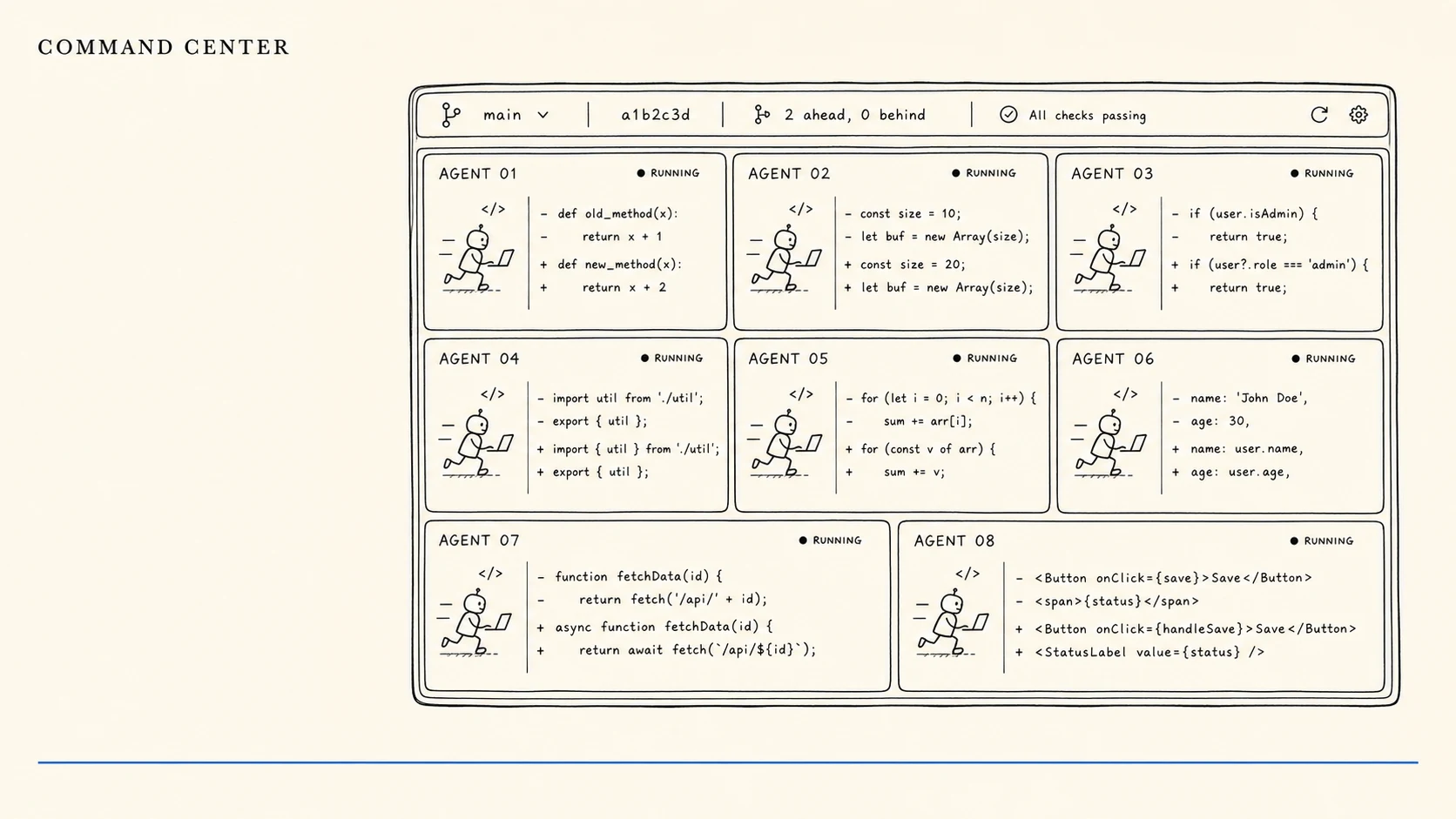
Every ranking article this year asks the same question. Which coding agent wins, Codex or Claude Code or Cursor? In 2026 that’s the wrong question, because the tools became visually interchangeable inside a single quarter. Open any of them and you meet the same cockpit: a list of running agents, a diff panel, a git bar, a toggle between local and cloud. When six teams independently land on one layout, the layout has stopped being a differentiator.
So the convergence is the story, not the comparison. This post is about what it means when the UI stops being a moat, and about a quieter thing the cockpit gives away. A rich supervision surface is partly a confession of how little we still trust these agents to run on their own.
Key Takeaways
- Six tools shipped the same parallel-agent command center between February 5 and July 9, 2026: VS Code, Cursor, Claude Code, Antigravity, Devin Desktop, and Codex (VS Code; Devin, 2026). The orchestration UI converged on one shape.
- Codex crossed 5M+ weekly active users by June 2026, roughly 6x its February desktop launch (Constellation Research, 2026). Distribution and lock-in, not pixels, are the story.
- When the cockpit is table stakes, differentiation moves to four places: model quality, ecosystem and skills, cloud infra, and lock-in (subscription plus data gravity).
- Benchmark leadership splits by axis. Claude Fable 5 leads pure code (SWE-Bench Pro ~80.3% vs Sol 64.6%); GPT-5.6 Sol leads agentic tasks (Terminal-Bench 2.1: Sol Ultra 91.9% vs Claude Mythos 5 88.0%) (BenchLM; The Agent Report, 2026).
- The contrarian read: a rich agent UI is a confession of distrust. We build diff reviews and “expand any subagent to see its full prompt” because we won’t yet let agents run headless.
What actually shipped on July 9?
On July 9, 2026, OpenAI folded the Codex app into the new ChatGPT desktop app, uniting Chat, Work, and Codex in one surface. It landed the same day GPT-5.6 (Sol, Terra, and Luna) went generally available across ChatGPT, Codex, and the API (Neowin; The Agent Report, 2026). Codex did not disappear. It became a dedicated coding surface living inside a single app, one subscription, one login.
The rebrand arc is worth one paragraph, because it explains the shape. Codex started in 2021 as a GPT-3 model for code, was retired in 2023, then came back in 2025 as an agentic product with its own model line. In 2026 the pace picked up. On May 16, OpenAI merged the ChatGPT and Codex teams under Greg Brockman and called the result “one agentic platform,” reportedly ahead of a confidential S-1 at an $850B+ valuation (Digital Applied, 2026). The July 9 desktop merge is the consumer-facing end of that decision.
What matters here is not the org chart. It’s that the merge completed a move from “a coding tool you open” to “a coding surface inside the app you already live in.” That framing (one platform, one subscription, one surface) is a distribution play, and I’ll come back to why that’s the actual moat.
Citation capsule: On July 9, 2026, OpenAI merged the standalone Codex app into the new ChatGPT desktop app, uniting Chat, Work, and Codex on macOS and Windows, the same day GPT-5.6 (Sol, Terra, Luna) reached general availability (Neowin; The Agent Report, 2026). The merge completed a five-year rebrand into “one agentic platform,” first announced as a team merger under Greg Brockman on May 16, 2026.
Why did the Codex GUI feel like a step forward?
Reviewers gave Codex an unusual amount of credit for its interface. One widely shared take called it “the first GUI for agentic coding that feels like a step forward, not backward,” and argued flatly that “the UI is the real product.” Every’s Dan Shipper reported his own usage moving from an 80/20 split favoring Claude Code to a roughly 50/50 split after the release (Every, 2026). For a reviewer to move that far on interface alone is a strong signal.
What earned it? The specifics, not the polish. Codex pulled the whole agentic loop into one window: a consolidated git bar for commit, push, and worktrees; toggles between a terminal and an IDE view; diff review with inline editing in the side panel; and an Agent Sessions view that unifies local, background, and cloud agents. You can expand any subagent to read its full prompt and its result. Parallel agents run in isolated git worktrees, and a cloud-to-local handoff preserves not just uncommitted state but live MCP connections. Add Skills, Automations, an in-app browser, SSH to devboxes, and multi-repo projects, and you get a cockpit rather than a chat box.
Is a nicer diff panel really worth writing home about? On its own, no. The reason it landed is that agentic coding had been getting worse to supervise as it got more capable. More agents, more background work, more parallel edits, all funneled through a single scrolling transcript. Codex made the supervision surface catch up to the autonomy. That’s the part reviewers felt as progress.
I ran the same non-trivial task, a multi-file refactor plus a test pass, across two of these command centers in parallel worktrees. The model output was close enough that I’d struggle to pick a winner blind. The orchestration was not. One made it obvious which agent was waiting on me and which diff I hadn’t reviewed; the other buried that state. That gap, the ergonomics of supervising several agents at once, is what the cockpit is really selling. It is also, I’ll argue later, a tell.
Citation capsule: Codex earned reviewer praise for making agentic-coding supervision feel like progress rather than regression. Every’s Dan Shipper shifted from an 80/20 Claude Code/Codex usage split to roughly 50/50 on the release, and described the interface as “the real product” (Every, 2026). The draw was concrete: unified local, background, and cloud agent sessions, inline diff review, and parallel agents in isolated git worktrees.
Did everyone really ship the same thing?
Yes, and in about four months. Between February 5 and July 9, 2026, six tools shipped the same command-center shape: VS Code multi-agent (Feb 5), Cursor 3 “Glass” (Apr 2), the Claude Code desktop redesign (Apr 14), Google Antigravity 2.0’s Agent Manager (May 19), Windsurf becoming Devin Desktop (Jun 2), and Codex-in-ChatGPT (Jul 9) (VS Code; Devin, 2026). This is the spine of the argument, so look at the detail that proves convergence in each.
Cursor 3 replaced Composer with an Agents Window that runs up to eight parallel agents in isolated worktrees (Digital Applied, 2026). Claude Code’s redesign moved the unit of work from the session to the workspace and put you in what Anthropic called “the orchestrator seat,” adding cloud Routines (Anthropic, 2026). Antigravity 2.0 removed the IDE from the center of the screen and promoted a standalone Agent Manager with scheduled background tasks (WinBuzzer, 2026). Devin Desktop made the Agent Command Center the default surface and added support for the Agent Client Protocol (Devin, 2026). Same shape, six times.
Convergence this fast is rarely imitation of one leader. It’s the shape the problem forces once agents can run in parallel and in the background. The moment you have more than one agent working at once, you need somewhere to see them, isolate them, and review their diffs. Every team hit that constraint and drew the same box. When independent teams arrive at one design under the same pressure, the design is a commodity, not an edge.
Citation capsule: Between February 5 and July 9, 2026, six coding tools converged on the same parallel-agent command center: VS Code multi-agent, Cursor 3’s Agents Window (up to eight parallel agents), the Claude Code “orchestrator seat” redesign, Antigravity 2.0’s Agent Manager, Devin Desktop’s Agent Command Center, and Codex-in-ChatGPT (VS Code; Anthropic; Devin, 2026). Independent convergence on one layout means the layout is table stakes, not a differentiator.
If the UI is everywhere, where’s the moat now?
When the cockpit is table stakes, differentiation moves off the interface and onto four things: model quality, ecosystem and skills, cloud infrastructure, and lock-in. Codex is the clearest example, because its edge in 2026 is a growth-and-distribution story, not a design one. It passed 5M+ weekly active users by June 2026, about 6x its February desktop launch, after hitting 4M weekly developers in late April from roughly 600K in January (Constellation Research; Digital Applied, 2026).
The composition of that growth matters more than the total. Non-developers are now about 20% of Codex users and growing roughly 3x faster than developers, and non-developer enterprise adoption grew 189x against its August 2025 baseline (Constellation Research; Crypto Briefing, 2026). That’s not a coding-tool curve. It’s a distribution curve, driven by putting a coding surface inside an app that hundreds of millions already open. “One subscription, one surface” is the moat, and it’s made of reach and lock-in, not pixels.
This is the uncomfortable part for anyone who just standardized a team on the prettiest cockpit. If the UI is commodity and the moat is distribution and lock-in, then the thing you’re really choosing is whose ecosystem to be captured by. Choose the model economics and the exit costs you can live with, because those are the parts that won’t converge away.
Citation capsule: With the command-center UI commoditized, differentiation moved to models, ecosystem, infrastructure, and lock-in. Codex passed 5M+ weekly active users by June 2026 (about 6x its February launch), with non-developers around 20% of users and non-developer enterprise adoption up 189x versus its August 2025 baseline (Constellation Research; Crypto Briefing, 2026). That is a distribution curve, not a design one.
So which one is actually best?
It depends on the axis, and this is where most coverage flattens something it shouldn’t. On pure code, Claude still leads: in 2026, Fable 5 topped SWE-Bench Pro at about 80.3% against Sol’s 64.6%, a roughly 15-point gap on patch generation (BenchLM, 2026). On agentic tasks, GPT-5.6 leads. On Terminal-Bench 2.1, Sol Ultra scored 91.9% and base Sol 88.8%, against Claude Mythos 5 and GPT-5.5 at 88.0%. Sol also sits first on the Artificial Analysis Coding Agent Index at 80 (The Agent Report; Artificial Analysis, 2026).
| Axis | Benchmark | Claude | GPT-5.6 | Leader |
|---|---|---|---|---|
| Pure code | SWE-Bench Pro | Fable 5: 80.3% | Sol: 64.6% | Claude, by ~15.7 pts |
| Agentic | Terminal-Bench 2.1 | Mythos 5: 88.0% | Sol Ultra: 91.9% | GPT-5.6, by ~3.9 pts |
Why does the split matter for tool choice? Because a command center is an agentic harness, and the tool that wins the cockpit war can be a different vendor from the model that wins patch generation. You can run GPT inside Claude Code without giving up the harness, then evaluate the models yourself against your own tasks instead of trusting a single leaderboard. Pricing widens the gap further: GPT-5.6 comes in tiers, with Sol at roughly $5/$30, Terra at $2.50/$15, and Luna at $1/$6 per million input/output tokens (Eden AI, 2026). The “best” tool usually resolves into “best model for this axis, run in whatever harness fits my team.”
Citation capsule: Benchmark leadership splits by axis, not by winner. In 2026, Claude Fable 5 led pure code on SWE-Bench Pro (about 80.3% vs Sol’s 64.6%), while GPT-5.6 Sol Ultra led agentic tasks on Terminal-Bench 2.1 (91.9% vs Claude Mythos 5’s 88.0%) (BenchLM; The Agent Report, 2026). Because a command center is an agentic harness, the tool that wins the cockpit and the model that wins patch generation can be different vendors.
Is a great agent UI actually a confession?
Here’s the contrarian read. The richer the cockpit, the less we actually trust the agent. Diff review panels, “expand any subagent to see its full prompt,” multi-session sidebars, and manual local-versus-cloud routing all exist for one reason: headless autonomy isn’t trusted yet. The UI is scaffolding for supervision. It’s the set of handrails we build because we won’t step away.
Follow the logic against the trust arc. If we genuinely trusted these agents, we’d want fewer approval surfaces, not more. We’re still gating agents behind permission prompts, still reviewing every diff, still expanding subagents to read their prompts, because we don’t believe the output until we’ve watched the work. That’s rational today. But it means a great agent UI is measuring our distrust as much as the tool’s capability. The cockpit exists to manage the gap between what agents can do and what we’ll let them do unattended.
The honest limitations point the same way. Codex is a command center, not a full editor; it’s macOS-first with Windows lagging; it’s locked to OpenAI’s stack; and routing between local and cloud is still a manual call the human makes. Some reviewers still say that any GUI on top of an agent “feels like a step backward” (Every, 2026). They’re describing the same tension from the other side. So here’s the prediction: the endgame isn’t a prettier cockpit, it’s a smaller one. As autonomy earns trust, the supervision surface should shrink, not grow. Watch whether your team’s agent UI is getting richer or leaner. That tells you which direction trust is actually moving.
Citation capsule: A rich agent cockpit is partly a confession of distrust in headless autonomy. Diff reviews, subagent-prompt inspectors, multi-session sidebars, and manual local-versus-cloud routing are supervision scaffolding, built because we won’t yet let agents run unattended. Some reviewers still call any GUI over an agent “a step backward” (Every, 2026). If trust grows, the surface should shrink, not expand.
FAQ
Is Codex better than Claude Code in 2026?
It depends on the axis. Claude Fable 5 leads pure code, scoring about 80.3% on SWE-Bench Pro against Sol’s 64.6%, while GPT-5.6 Sol leads agentic tasks, scoring 91.9% (Sol Ultra) on Terminal-Bench 2.1 against Claude Mythos 5’s 88.0% (BenchLM; The Agent Report, 2026). Pick by workload, not by brand.
Why do AI coding tools all look the same now?
Because six shipped the same parallel-agent command center between February 5 and July 9, 2026: VS Code, Cursor, Claude Code, Antigravity, Devin Desktop, and Codex (VS Code; Devin, 2026). Parallel and background agents force one shape: a place to launch, isolate, and review them. Independent teams drew the same box.
What is a parallel-agent command center?
It’s a workspace where you launch and supervise several agents at once, each in an isolated git worktree or cloud sandbox, and review their diffs, rather than typing into a single chat or terminal. Cursor 3 runs up to eight in parallel (Digital Applied, 2026). It puts the human in an orchestrator role over many agents.
Should I run coding agents headless or in a GUI?
Today most teams supervise through a GUI because headless autonomy isn’t fully trusted, and the cockpit exists to manage that distrust (Every, 2026). Expect the surface to shrink as autonomy earns trust. If you already trust a workflow, headless or scripted runs cut the supervision overhead the GUI is designed to carry.
Conclusion
The UI converged, so it’s now commodity. Six coding tools shipped the same parallel-agent command center in a single quarter, which means the cockpit is table stakes and the moat moved elsewhere: to model quality, to ecosystem and skills, to cloud infrastructure, and to lock-in. Benchmark leadership splits by axis, with Claude ahead on pure code and Codex ahead on agentic tasks, so “which tool is best” resolves into “which model for which job, in whatever harness fits.” And “which model” increasingly includes an open-weight option: the open-weight floor is the realistic alternative to a single-vendor model stack. And the cockpit itself is a trust artifact: we build rich supervision surfaces precisely because we won’t run agents headless yet.
So don’t standardize on the prettiest cockpit. Standardize on the model economics and the lock-in you can live with, and watch whether your team’s agent UI is growing (distrust) or shrinking (trust). If the boxes keep multiplying, that’s a signal about autonomy, not about design. When you do run several agents at once, the real skill is orchestration, from long-running autonomous agents to spawn-versus-stay subagent patterns and supervising work across parallel sessions. The command center just gives that skill a window. The endgame is less window, not more.
Sources
- Neowin, OpenAI launches ChatGPT Work and unveils unified desktop app with Codex built in, retrieved 2026-07-16.
- Coursiv, Codex merged with the ChatGPT app, retrieved 2026-07-16.
- Digital Applied, OpenAI merges ChatGPT and Codex teams under Brockman, retrieved 2026-07-16.
- The Agent Report, GPT-5.6 Sol, Terra, Luna: benchmarks and pricing analysis, retrieved 2026-07-16.
- Artificial Analysis, GPT-5.6 has landed, retrieved 2026-07-16.
- Eden AI, GPT-5.6 Sol benchmarks, pricing, and API access guide, retrieved 2026-07-16.
- BenchLM, Claude Fable 5 vs GPT-5.6 Sol, retrieved 2026-07-16.
- Every, Codex vibe check, retrieved 2026-07-16.
- Constellation Research, OpenAI touts broadening Codex usage, 5 million weekly active users, retrieved 2026-07-16.
- Digital Applied, OpenAI Codex 4M weekly developers growth data, retrieved 2026-07-16.
- Crypto Briefing, OpenAI Codex internal adoption non-developer surge, retrieved 2026-07-16.
- VS Code, Multi-agent development, retrieved 2026-07-16.
- Digital Applied, Cursor 3 Agents Window complete guide, retrieved 2026-07-16.
- Anthropic, Claude Code desktop redesign, retrieved 2026-07-16.
- WinBuzzer, Introducing Google Antigravity 2.0, retrieved 2026-07-16.
- Devin, Windsurf is now Devin Desktop, retrieved 2026-07-16.
If it was useful, pass it along.