UI Libraries vs AI-Generated Components: The Tailwind Substrate
v0 hit 4 million users with more than half of revenue coming from Teams and Enterprise customers, and parent Vercel raised a $300M Series F at a $9.3B valuation off the back of it (Vercel Series F, 2025; GIC, 2025). Lovable reached $200M ARR and a $6.6B valuation in the year after launch. shadcn/ui’s weekly npm downloads passed Chakra and Mantine in early 2026, climbing from roughly 200,000 a week in March 2025 to roughly 560,000 a week by January 2026 (Magic Patterns, 2026). These are not three trends. They are the same trend measured from three angles.
The convergence was set by what came underneath. State of CSS 2025 puts Tailwind at 51% framework share, with Bootstrap second at 30% and “None” third at 27% out of 3,977 framework respondents (State of CSS, 2025). Tailwind is what the AI generators emit, and that is not aesthetic preference. It is the substrate decision an LLM makes, every prompt, when given a choice between an atomic-class output and a runtime CSS-in-JS one. The library-versus-AI debate is the wrong question. The right question is which substrate the team owns and which tier the generator composes against. This post names that question, calibrates the adoption picture, walks the maintenance-decay curve, and offers a four-quadrant placement framework.
Key Takeaways
- Tailwind made the substrate LLM-shaped. State of CSS 2025: 51% framework share against 30% for Bootstrap and 27% for none (State of CSS, 2025). Generators converged on the most common, most token-predictable output.
- shadcn is the architectural bridge, not a fourth library. The CLI generates source you own; AI generators edit files in your repo, not calls to a library API. Weekly downloads jumped from ~200k (Mar 2025) to ~560k (Jan 2026) (Magic Patterns, 2026).
- AI-generated components decay on a four-phase curve: rapid prototyping (weeks 0-4), consistency drift (months 1-3), accessibility debt (months 3-6), substrate retreat (month 6+). Stack Overflow 2025: 66% of developers spend more time fixing “almost-right” AI code; 45% cite this as their #1 frustration (SO 2025, 2025).
- Place each surface on a four-quadrant grid (component criticality times change rate). High-criticality surfaces use a closed library or headless primitives; design-system foundations use the shadcn pattern; throwaway surfaces use pure AI generators.
- The productivity case is real (GitHub Copilot studies measure 55.8% faster task completion), and the trust case is also real (29% of developers trust AI accuracy, down 11 points year over year). Both are true. The substrate decides which one dominates in production.
Tailwind made the substrate LLM-shaped
Tailwind CSS holds 51% framework share among State of CSS 2025 respondents (2,041 of 3,977; Bootstrap second at 30%; “None” third at 27%; the survey ran across 11,000 respondents in total). v0 emits Tailwind. Lovable emits Tailwind. Bolt emits Tailwind. Claude Artifacts emit Tailwind. Cursor’s UI generation emits Tailwind. The convergence is not coincidence; it is token economics. An LLM emitting bg-zinc-50 px-6 py-4 rounded-lg shadow-sm produces a complete, deterministic styled output in one shot. An LLM emitting CSS-in-JS produces a partial output that depends on a runtime, a theme object, and a set of variant props the generator cannot see in a single window.
The runtime CSS-in-JS retrospective tells the rest of the story. Spot’s “Why we are breaking up with CSS-in-JS” measured a 48% render-time reduction (54ms to 27.7ms) when removing the Emotion runtime; styled-components ships at roughly 12.7kB minified, Emotion at roughly 7.9kB (Spot, 2022; InfoQ, 2022). Compile-time atomic CSS won the human runtime debate years ago. What is new is that the same shape that wins on cold-start render time also wins on token economics: Tailwind classes are atomic, predictable, and scope-free, the kind of pattern an LLM has seen millions of times in training and can emit without consulting external context. The constraint sits one layer above the styling framework. The substrate the team owns is also the context window the LLM gets to read; the more LLM-legible the substrate, the more reliable the output. GitHub Octoverse 2025 quantifies the corpus shift directly: public repos importing an LLM SDK grew 178% year over year to more than 1.1 million repositories, and TypeScript surpassed both Python and JavaScript as the number-one language on GitHub (Octoverse, 2025). The training corpus tilted toward TypeScript plus Tailwind, and the generators followed.
The substrate argument is a special case of the code-shape thesis covered earlier: code shape determines AI quality. Tailwind plus shadcn is the most LLM-legible shape the frontend has produced.
shadcn is the bridge, not a fourth library
shadcn/ui’s weekly npm downloads passed Chakra (~587k) and Mantine (~490k) in early 2026, landing at roughly 560,000 a week against MUI’s ~6.7 million (Makers’ Den, 2025; Magic Patterns, 2026). The numbers misrepresent the architecture. shadcn is not “a library you install.” It is a CLI that copies primitive components into your repo as files you own, built on Radix headless primitives, styled with Tailwind. The package is a code generator. The output is your source.
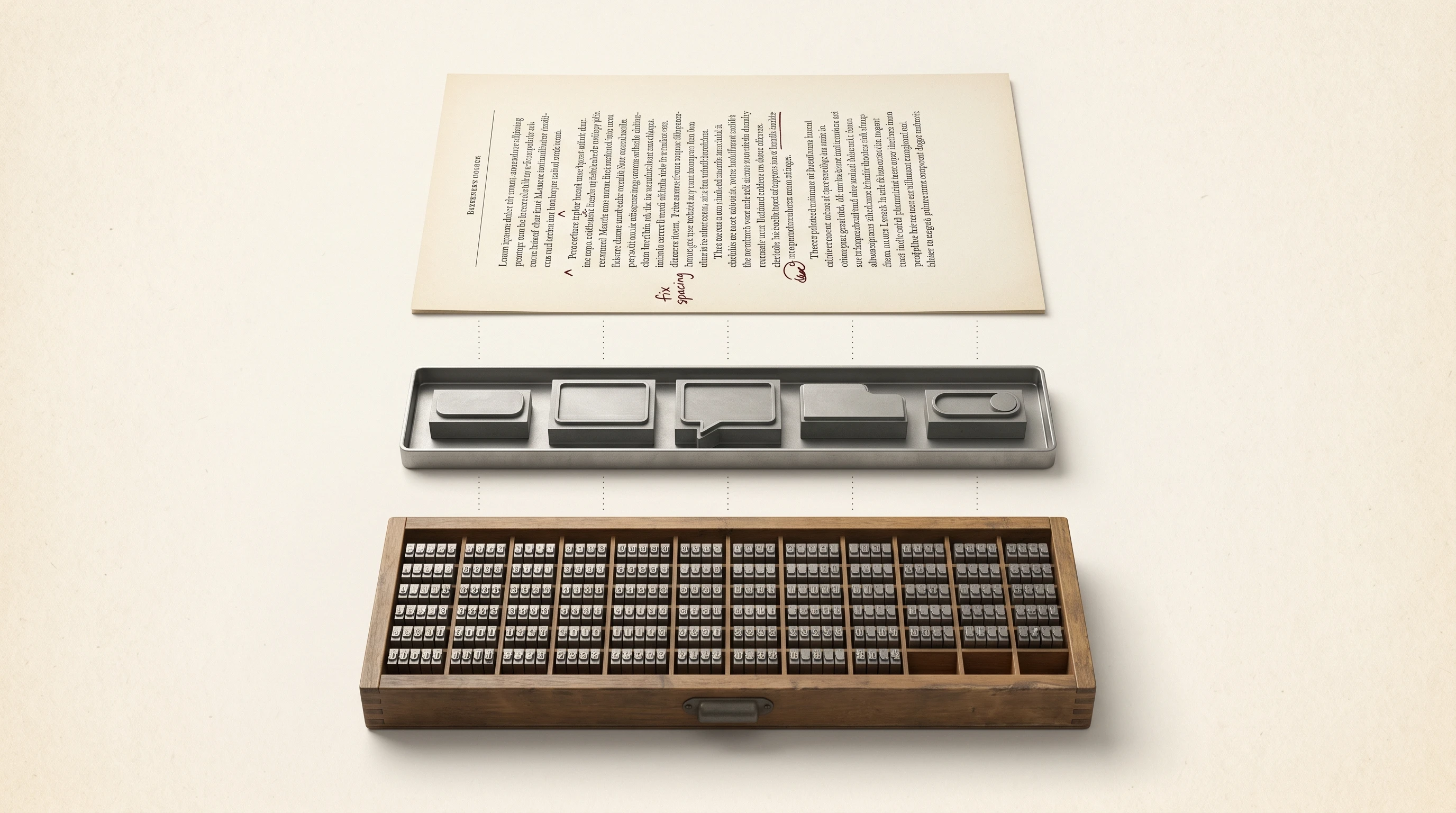
The four-tier taxonomy makes the distinction sharp.
A closed library like MUI, Ant Design, or Mantine asks you to import. The library owns the source. Theming is API-shaped (theme objects, props, context providers); accessibility is whatever the maintainer ships. AI generators cannot compose against the library without knowing the API surface call by call, which is precisely what training data is thin on for proprietary component libraries.
A set of headless primitives like Radix UI, React Aria, or Headless UI also asks you to import, but the import owns only behaviour: focus management, keyboard navigation, ARIA wiring. You own the styling. AI generators can compose styling against the primitives if they have seen the primitives’ API in training, which they have for Radix and React Aria after years of public use.
The shadcn pattern is the third tier. You generate once via CLI; the source lives in your repo; the registry ships future updates as recipes you choose to re-pull. AI generators compose against files that already live in your repo, in the substrate they are best at (Tailwind on Radix). Critically, an AI editing a Card.tsx in your repo is editing a file, not calling a library API. The training distribution for “edit this React component” is enormous. The training distribution for “call MUI’s <DataGrid pageSize={...}> correctly” is much smaller and older.
A pure AI generator (v0, Lovable, Bolt, Claude Artifacts, Cursor) is the fourth tier. You prompt; the generator emits Tailwind plus JSX; you own the output but did not author it. Each emission is independent. There is no shared primitive base. Maintenance and consistency are your problem from the moment the file lands.
The accessibility datapoint sharpens why the bridge tier matters. WebAIM Million 2026 found 95.9% of the top one million home pages have at least one detectable WCAG 2 failure (an average of 56.1 errors per page), and ARIA usage rose 27% year over year. ARIA-heavy pages averaged 59.1 errors versus 42 errors on pages without ARIA, a roughly 41% worse outcome (WebAIM Million, 2026). AI generators love sprinkling ARIA. Headless primitives that own the wiring (Radix, React Aria) are the safer base than letting a generator emit ARIA from scratch on every output. The shadcn pattern inherits Radix’s wiring by construction, which is the architectural unlock for AI-edited components in production code rather than throwaway prototypes. The principle echoes the substrate-ownership argument made for agent skills: the durable artefact is the one your team owns and the AI edits in place.
The adoption picture in five numbers
No public source assembles the picture in one place. Five numbers tell the same story from different angles. (1) Tailwind: 51% State of CSS 2025 share. (2) shadcn/ui: 104,000-plus GitHub stars and roughly 560,000 weekly npm downloads as of January 2026, up from roughly 83,000 stars and 200,000 weekly in March 2025. (3) v0: more than 4 million users with Teams and Enterprise contributing more than 50% of revenue, parent Vercel valued at $9.3B at the September 2025 Series F (SaaStr, 2026). (4) Lovable: $200M ARR and a $6.6B valuation by December 2025; reached $20M ARR in 60 days from launch. (5) Bolt.new: $40M ARR within six months of its October 2024 launch.
The productivity gain from working in this stack is real and measured. GitHub Copilot’s controlled study put developers 55.8% faster on a constrained task (2h41m down to 1h11m), with the success rate moving from 70% to 78% (Octoverse / GitHub Research, 2024). Stack Overflow Developer Survey 2025 reported 84% of developers using or planning to use AI tools, up from 76% the year before (Stack Overflow, 2025). The trust gap is also real: only 29% trust AI accuracy (down 11 points year over year); 66% report spending more time fixing “almost-right” AI code, 45% calling that their number-one frustration; 77% say “vibe coding” is not part of their professional work (Stack Overflow 2025 AI section, 2025). The inference for engineering leaders is not “AI is good” or “AI is bad.” It is that the productivity gain comes from the substrate, not from the AI alone; an AI generator emitting a hostile substrate would not have produced these adoption numbers. The substrate is what made the productivity legible.
The team-as-AI framing developed earlier makes the practical point. The teammate’s quality is bounded by the substrate the teammate composes against. Pick the substrate first.
AI components decay on a four-phase curve
AI-generated components depreciate on a curve no current top-ranking comparison post quantifies. Three pressures compound. Stack Overflow 2025: 66% of developers spend more time fixing AI’s almost-right output. WebAIM Million 2026: 95.9% of top one million home pages already fail WCAG, and AI generators tend to make it worse on ARIA-heavy markup. Design-system divergence: each emission is independent, with no shared primitive base, so visual and interaction patterns diverge every prompt. The four-phase model that follows is grounded in those three datapoints; the phase boundaries are empirical bands, not promises.
Phase 1, weeks 0 to 4. Rapid prototyping. The decay is invisible because there is nothing to decay against. The team ships landing pages, marketing experiments, and one-off internal tools. AI generators are net-positive. Productivity gain dominates everything else.
Phase 2, months 1 to 3. Consistency drift. First production users hit the components. Spacing, typography, focus rings, and interaction patterns diverge between AI-generated and team-authored surfaces. Designers file tickets that read “this should match the rest of the app” without naming a primitive that defines what “the rest of the app” is. Detection signals: visual regression tests against a reference component start failing in unexpected ways; PR review pulls hits on design-token compliance. The same regression-detection discipline used to backtest agent behavior over time maps directly onto component drift, because both problems are “right answer two months ago, wandered since.” The earliest Phase-2 signal in practice is design review surfacing the same complaint twice in one week on different surfaces. The substrate underneath was never set, so every emission picked its own.
Phase 3, months 3 to 6. Accessibility debt surfaces. WCAG audits or assistive-tech users find the ARIA errors. The markup passed visual review and failed conformance review. WebAIM Million 2026 quantifies the ambient floor: 95.9% of homepages already fail. AI-generated UI compounds the failure rate because generators emit ARIA defensively and the wiring is not always coherent. Detection: axe-core in CI, a Lighthouse accessibility score floor, and screen-reader sampling on every new surface. The PR-review-as-detection pattern covered here is the cheapest route to surfacing Phase-2 and Phase-3 signals before the audit does.
Phase 4, month 6 plus. Substrate retreat. The team retreats to one of three substrates: a closed library (give up the productivity gain), headless primitives (rebuild the components from scratch), or the shadcn pattern (port the generator output onto a primitive base, keep the AI for compositions only). Phase 4 is when the substrate question stops being abstract and starts being a sprint plan. The contrarian acknowledged: some teams ship marketing-only products that never reach Phase 2 because the surface dies first. The decay model assumes the surface lives more than six months. The explicit recommendation is the inverse: do not let pure-generator output land in product surfaces past Phase 1 unless the substrate underneath is shadcn-pattern. The AI has to be editing your files, not authoring new ones.
The four-quadrant placement framework
Engineering leaders need a placement framework, not a recommendation. Two axes determine the right substrate per surface: component criticality (high if accessibility-mandatory, brand-load-bearing, or used at scale; low if throwaway, internal, or marketing) and change rate (high if it iterates weekly; low if it stays stable for quarters). The four resulting quadrants give a clean placement rule per surface.
| Quadrant | Example surfaces | Recommended substrate |
|---|---|---|
| High criticality, low change rate | Data tables, billing flows, auth UI | Closed library or headless primitives |
| High criticality, high change rate | Product surfaces, design-system foundations | shadcn pattern (owned source, AI for compositions) |
| Low criticality, low change rate | Legal pages, footer, contact form | Closed library or pure generator (either is cheap) |
| Low criticality, high change rate | Marketing experiments, A/B variants, internal admin | Pure AI generator (v0, Lovable, Bolt) |
High criticality, low change rate. Data tables, billing flows, auth UI. Closed library or headless primitives. Examples: MUI DataGrid for the data-grid problem nobody wants to rebuild every two years; Radix Dialog for modals that have to handle focus correctly. The cost of an accessibility miss or a behavioural regression dominates the productivity gain. AI generator output is acceptable as initial scaffolding, but the production version sits on a substrate the team trusts.
High criticality, high change rate. Product surfaces, design-system foundations. The shadcn pattern wins this quadrant. Owned source over Radix primitives, styled with Tailwind, AI used for compositions only. The combination tolerates rapid iteration (because the AI can edit the files in place) and preserves accessibility (because the wiring lives in primitives the team did not author).
Low criticality, low change rate. Legal pages, footer, contact form. Closed library is fine; the productivity gain matters less than maintainability, and these surfaces almost never change. Pure-generator output is fine here too if the team enjoys its aesthetics. Either choice is cheap.
Low criticality, high change rate. Marketing experiments, A/B variants, internal admin tools. Pure AI generator. The decay curve does not bite because the surface either dies or gets rewritten before Phase 2 hits. v0 and Lovable were built for this quadrant; pretending they need a substrate retreat is over-engineering.
The application notes are short. Criticality is a function of “who fails when this breaks?” Change rate is a function of “how often does this surface update?” Small teams under-engineer the high-criticality quadrants because the productivity gain is visible and the decay is not yet. Large teams over-engineer the low-criticality quadrants because the placement framework defaults to “use the design system.” Both are placement errors, and both are cheaper to fix on a grid than on prose. The contrarian: some teams pick one substrate everywhere and accept the misplacement tax. That is fine if the engineering organization is small enough that placement decisions cost more than misplacement does. The placement framework is, like all frameworks, an overhead. Placement is the practice that survives the next paradigm shift; the substrates underneath will keep moving.
When you should not engineer the substrate
Not every team needs the framework. Two filters: weekly frontend velocity exceeds three engineers shipping daily, or the product has surfaces in two or more quadrants of the placement framework. Below that bar, picking shadcn-pattern as the default and using v0 or Lovable for one-off prototypes is the right answer. The placement framework is overhead when the team only has one quadrant of surface to build.
The Stack Overflow 2025 finding that 77% of developers say “vibe coding” is not part of their professional work is the median signal: most teams are not at the stage where AI generators are load-bearing in production. The cost of premature substrate engineering is real: over-engineering the design system before it has consumers, building a primitive base for a marketing-only product, or paying the framework’s overhead before the team has surfaces in more than one quadrant. The default for teams below the threshold is short. Use shadcn-pattern as the base. Use v0 or Lovable for one-off marketing surfaces. Accept the productivity gain on the simplest substrate that works. Revisit the framework when the surface count crosses two quadrants, not before.
What now?
Three takeaways for the build conversation.
- Tailwind made the substrate LLM-shaped. The 51% framework share, the v0 4 million users, and the shadcn 560,000 weekly downloads are the same number measured from three angles.
- shadcn is the architectural bridge, not a fourth library. The CLI generates source you own; AI generators edit files in your repo, not calls to a library API. This is the unlock for AI-edited components in production code.
- The library-versus-AI question is the wrong question. Substrate placement (closed library, headless primitives, shadcn-pattern, pure generator) is the right one. Two axes (criticality, change rate) decide it.
Place every surface in your product on the four-quadrant grid this week. If you find pure-generator output in a high-criticality quadrant, the decay curve is already running. The cheapest port is back onto the shadcn pattern: the AI keeps editing files, but the files now sit on a primitive base your team did not have to author.
Frequently Asked Questions
Should I use a UI library or AI-generated components in 2026?
Both, placed by quadrant. High-criticality surfaces (data tables, billing flows, auth UI) belong on a closed library (MUI) or headless primitives (Radix). Design-system foundations belong on the shadcn pattern (owned source, AI for compositions). Throwaway surfaces (marketing experiments, A/B variants) belong on pure AI generators (v0, Lovable). The library-versus-AI question is the wrong frame; component criticality and change rate determine the right substrate (Stack Overflow, 2025).
Why does AI generate Tailwind code so well?
Tailwind classes are atomic, deterministic, scope-free tokens an LLM has seen millions of times in training. CSS-in-JS forces multi-file context (theme objects, runtime imports, variant props) the generator cannot see in a single output. State of CSS 2025 puts Tailwind at 51% framework share against Bootstrap’s 30% and “None” at 27% (State of CSS, 2025). The training corpus tilted toward Tailwind, and the AI generators followed.
Is shadcn/ui better than MUI for AI workflows?
For AI-edited components, yes. shadcn copies source files into your repo via CLI, so the AI is editing files you own rather than calling a library API. The training distribution for “edit this React component” is much larger than for any specific library’s call signature. MUI is better when you need a maintained data-grid, complex theming, or enterprise support contracts. The choice is between substrate ownership (shadcn) and substrate vendor support (MUI), not between newer and older.
When do AI-generated components break?
Around month 3 in production. Stack Overflow 2025 found 66% of developers spending more time fixing “almost-right” AI code; 45% call this their number-one frustration (Stack Overflow 2025, 2025). WebAIM Million 2026 found 95.9% of top one million homepages failing WCAG and ARIA-heavy pages averaging 41% more errors (WebAIM, 2026). Pure-generator output shows consistency drift first (months 1 to 3), then accessibility debt (months 3 to 6), then forces a substrate retreat. Avoid the retreat by placing AI generators only in low-criticality surfaces.
If it was useful, pass it along.